Sunday, June 02, 2013

Intel Haswell Peformance -- LOL Anand is such an Intel pumper boy

Anand at AnandTech.com just published a review of Intel's Haswell CPUs. He started by worshiping Intel Haswell with words like "the most amazing thing",  "the single largest improvement",  "completely redefines the expectations", "the epitome of polish and evolution".

Then it comes with the his benchmark numbers. When operating with load, the Haswell i7-4770K(3.5GHz) consumes 113.2 watts, while the older i7-3770K (3.5GHz) consumes 101.1 watts.

Anand obviously noted that the Haswell consumes 11.968% ~ 12% more power than the Ivy Bridge (well Anand's number was 11.8%, I guess he might have run into one of those FDIV errors, but this minor error does not affect our general conclusion and we should not hold anyone liable). But Anand was quick to direct our attention to the very fact that Haswell i7-4770K is 13% faster than the previous generation.

So, Haswell is 13% faster but consumes 12% more electricity. What about performance-per-watt improvement?

PPW = performance/heat

PPW1/PPW2 = p1/h1 / (p2/h2) = p1/p2 * h2/h1 = 1.13/ 1.12   = 1.0089 = 100.89%.

In other words, Haswell's performance-per-watt is only 0.9% better than Ivy Bridge. Folks, that's less than 1%.

 Moreover, 0.89% is definitely within the margin of error and sample deviations, and it is safe to conclude that Haswell is no better than Ivy Bridge in terms of performance per watt.

Anand, though probably not a Ph.D.,  is certainly an intelligent person. So, the question is, why was Anand so high on so small an improvement?? Where did all those hyper words come from?


Monday, May 20, 2013

Refuting Arnold Frisch's Article at SeekingAlpha


The arrogant tone in Mr. Frisch's article is typical of Intel. But face the reality.

In the past decade, Intel has become a simple copycat of AMD technologies. AMD invented AMD64 (x64), multi-core x64, HyperTransport, ccHT, EMC (embedded memory controller), to name a few. Intel copycatted each and every one of these AMD innovations, without even acknowledge AMD's technological leadership. Intel can do this with impunity because of the cross-licensing agreements with AMD.

But AMD innovation in the APU arena finally leaves Intel in the dust.

AMD's control of the 3 gaming consoles is testimony to the APU paradigm shift. Anyone who failed to realize the importance of these developments have very little understanding of the ongoing convergence in computing. Any Inteler who fails to acknowledge the significance of this watershed development is in denial.

Intel has very little left technology wise, though it can still exercise monopoly power in x86, the industry is shifting away from that market.

Intel can still brag about its process technology, but even in this area, Intel's lead is shrinking. The FinFET Mr. Frisch mentioned is not invented or owned by Intel, it's done by university researchers. Other FABs are rolling out FinFET faster than Mr. Frisch claimed. TSMC will start 16nm FinFET chips in late 2013. GlobalFoundries will start 14nm FinFET production in late 2013 in their state of the art FAB8.


The author is naive to assume a faster processor must take over the slower one. Not so. Measure ARM against Atom, even though the Atom is slower than AMD Brazos, the Atom is faster than ARM. Why people are buying Apple IPads with ARM inside? People buy systems, not CPUs. An slower ARM CPU plus fast Apple iOS is much better than a faster Atom CPU plus crashing, bloating MS Windows.

What Intel lacks over the past decade is system level innovation. The stuff Intel is bragging about, the FinFET implementation, is indeed physics. But everyone else is using the same tools made by Applied Material and the like, Intel has no inherent advantage in using someone else's machinery. TSMC and GloFo are buying the same tools. Google TSMC FinFET, and GlobalFoundries FinFET 14XM, and enlighten yourself on the world out there. GloFo has the brain power of IBM research behind it, superior to anything Intel.

Right now, AMD is leading one of the convergence trend: GPGPU+CPU. Intel is at least two generations behind AMD in that regard. That's why both Xbox 720 and PS4 will be on AMD, with eight AMD64 cores and a supercomputer strength GPGPU, interconnected with hUMA.

What's more important is that Microsoft operating system and application software are being written specifically for AMD hUMA, which means Intel is out of the game.


Ref: http://seekingalpha.com/article/1447081-structural-change-in-the-mobile-processor-marketplace-intel-wins-arm-amd-lose?source=yahoo


Friday, May 03, 2013

AMD APU for Apple --

In the past decade, every time AMD innovated, Intel copycatted  AMD's innovation, while suppressing AMD's market expansion with its monopoly power.

AMD invented AMD64 (x64), multi-core x64, HyperTransport, ccHT, EMC (embedded memory controller), to name a few. Intel shamelessly copycatted each and every one of these AMD innovations, without even acknowledge AMD's technological leadership.

Intel can do this with impunity because of the cross-licensing agreements with AMD.

But AMD innovation in the APU arena finally leaves Intel in the dust.

Why? Hasn't Intel copycatted the APU concept from AMD also?

It is true Intel has also copycatted the APU design from AMD by integrating CPU and GPU. But AMD has acquired all of ATI's assets, and there is no cross-licensing of core ATI technologies with Intel. Furthermore, Nvidia has no interest in lending Intel a helping hand. As a result, Intel can only license second class graphics cores from obscure sources.

With AMD's control of the next gen game consoles, including PS4 and the rumored Xbox 720, and with the ability to custom design APUs equipped with high performance GPGPUs, Intel is playing a hopeless game of catch-up. Only Nvidia can help Intel, but even if Mr. Huang is willing to, it is probably too late.

Don't be surprised if the next gen Apple iPad runs on an AMD designed APU integrating ARM CPU cores and AMD Vision cores.

Tuesday, October 30, 2012

AMD may bring the end to x86

AMD's ARM based Opteron will cause a major plate tectonic shift in computing.

AMD is enslaved by the x86 instruction set controlled by Intel's licensing restrictions. With ARM, AMD can finally break free and dominate.

AMD has everything in its own sleeves: CPU, ccHT (cache coherent hypertransport), embedded memory controller, GPGPU and the Fabric. With the advent of Windows for ARM, the world can finally live without x86.

In five years, x86's share on desktop and mobile will be substantially reduced. In ten years, x86 will be almost gone.


Sunday, May 27, 2012

AMD Trinity Beats Intel i7 in Compute Performance

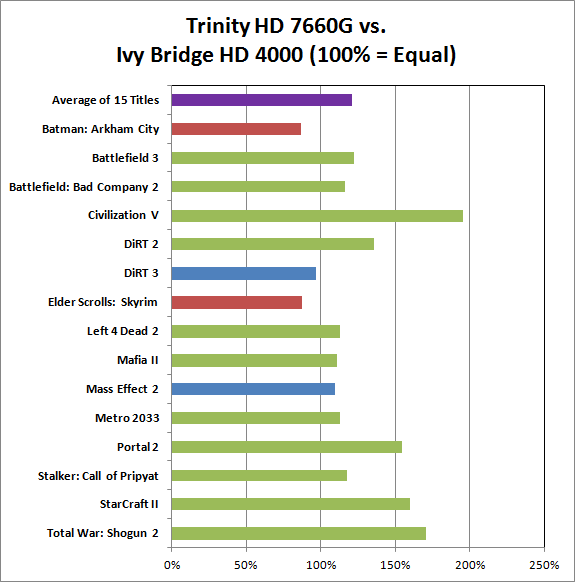
We know that Trinity destroys Intel i7 in 3D visual performance. If you look closer, Trinity is faster than Intel in many other areas. Check out the PCMark 7 benchmark scores below. Trinity soundly beats Intel i7+ Nvidia GPU in both creativity and computation.


Thursday, May 17, 2012

Rory Read can think outside the box

Finally, AMD found someone who can do it.

Wednesday, May 16, 2012

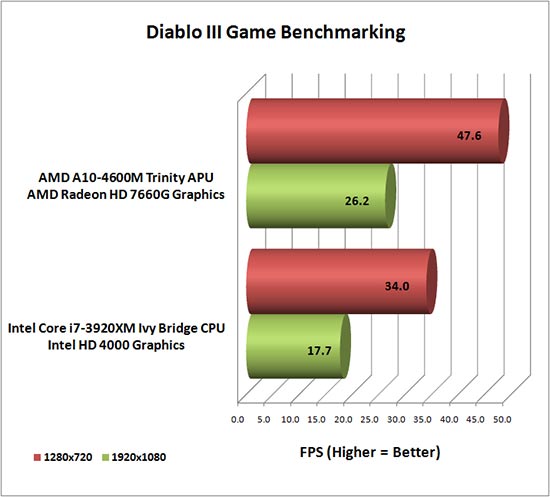
Trinity Destroys Intel i7-3920XM Extreme Edition

AMD's Trinity is 48% faster than Intel's Ivy Bridge Extreme i7-3920XM
Intel i7-3920XM specs:

Essentials
Status
Launched
Launch Date
Q2'12
Processor Number
i7-3920XM
# of Cores
4
# of Threads
8
Clock Speed
2.9 GHz
Max Turbo Frequency
3.8 GHz
Intel® Smart Cache
8 MB


Lithography
22 nm
Max TDP
55 W
Recommended Customer Price
$1096

Tuesday, May 15, 2012

AMD Trinity Battery Life 44% Longer than Intel Ivy Bridge

According to AnandTech. Also, the Trinity has 31.4% longer battery life than Ivy Bridge.

Monday, May 14, 2012

AMD says Intel Ivy Bridge having trouble doing 1080p

http://www.slashgear.com/amd-trinity-official-hands-on-14228174/

AMD’s head of desktop and software product marketing Sasa Marinkovic:

“30fps at 1080p is not something [Intel] can do easily with Ivy Bridge” Marinkovic says, but Trinity can.

Sunday, May 13, 2012

Intel CEO Sounds Very Irritated At Apple

hmm.... why?

Wednesday, May 02, 2012

Review: Intel CPU plays HD better than a slideshow

Very interesting review here: http://uk.hardware.info/reviews/2700/18/cpu-shoot-out-intel-atom-d2700-vs-amd-e-450-video-compatibility

As expected, the AMD E450 smashes the Atom D2700 in performance. In 3DMark the AMD chip gets a score of 2430, while the Intel achieves a pitiful 500!!

The Intel D2700 can't even play HD video continuously, though the reviewer says it's better than a slide show.

But, what is more surprising is the fact that the E450 built with TSMC's bulk 40nm process consumes LESS electricity than the Intel D2700 under load.

Tuesday, May 01, 2012

Intel Ivy Bridge Fragged by Old AMD A8 3870K

The old LLano 3870K frags Intel Ivy Bridge i7 3770K by a healthy 40% in 3DMark 2011.


http://www.theinquirer.net/inquirer/review/2171317/intel-ivy-bridge-hd-graphics-4000-review/page/2


Monday, April 16, 2012

SeaMicro Fabric + MIPS64 Low Power Core?

That combination seems to be a good one. Current x64 CPUs are still much more power hungry than the simple RISC chips.

Wednesday, March 21, 2012

GF Yields Doubled for AMD

AMD and GlobalFoundries made a major announcement today. AMD's Roy Read commended GF for "doubling of yields on 32nm". AMD will also use GF's 28nm HKMG processes, which "are qualified and ready for design-in today."

GF's FAB1 (former Dresden FAB of AMD) can now output 80,000 wafers per month.

That kind of capacity ought to be enough quench the APU thirst of Apple, HP, Lenovo, HP, Acer and others.

Thursday, March 08, 2012

Intel's Sour Grapes Untruth Exposed

In the past few days, we heard Intel execs saying that SeaMicro begged for Intel's acquisition, and Intel was unimpressed. The press, always ignorant, was thrown into confusion and doubt.

Now, SeaMicro's Fred Weber, former CTO of AMD, politely pointed out the truth without directly accusing Intel of lying.

According to a SeaMicro spokesperson, Intel "incorporated features into its roadmap at SeaMicro's request ... organized and facilitated numerous meetings with [SeaMicro] senior executives and participation in its own events, including a joint press conference just over a month ago ... "

But, "at no time did a SeaMicro executive, employee, agent, banker, approach Intel about selling SeaMicro to [Intel]."

It is ironic that AMD is gonna frag Intel with stacks of tightly packed Atoms.

No wonder Roy Read is laughing out loud.

But, if Fred Weber is telling the truth, the way to prove it is to sue Intel for defamation.


Tuesday, March 06, 2012

The World's First 4GHz x64 CPU Now Available

4.2GHz

http://www.newegg.com/Product/Product.aspx?Item=N82E16819106009&Tpk=fx-4170

Thursday, March 01, 2012

AMD's Apple Plan

Intel makes and sells a lot of CPUs, it owns 80% of the PC CPU market, but its market cap is only 25% of Apple.

With the SeaMicro acquisition, AMD will start selling cloud computing servers equipped with Intel's Atom chips.

The reason is simple. AMD's new CEO realizes that it is in the business of making money. And the Apple story says selling finished highend products brings in more profits.

The AMD SeaMicro technology shows that you actually don't need powerful and complex chips like the 16 core Opterons or Xeons, a bunch of Atoms can achieve similar effects. In ApacheBench for web performance, a single 10U AMD SeaMicro server with 512 Atoms can outperform 45 dual socket quad core servers, but uses 25% of the power and space consumed by the latter.

Intel would have no objections to that statement.

So that's how AMD is shifting its focus from the struggle with Intel to corporate profitability.

If Intel wants to grow like Apple, it will need to rethink its own goals too. A monopolistic mindset bent on deriving profits by eliminating competition does not seem to work well in the internet era.

Saturday, February 25, 2012

Adobe Flash is such a piece of junk

It crashes so often. Sometimes, it only crashes the browser, but a lot of times it crashes the whole computer. Now, this should never happen with a robust OS, but apparently, Windows 7 is so vulnerable, the bugs in Adobe Flash can crash the OS...

No wonder Steve Jobs said Adobe Flash people are lazy, and Flash does not fit Apple standards.

According to Jobs, "Apple does not support Flash because it is so buggy. Whenever a Mac crashes more often than not it’s because of Flash. No one will be using Flash."

Since Mac is BSD Unix based, I wonder whether the Intel Core i5 CPU is a part of the cause of those Flash crashes in the Macs.

Thursday, February 23, 2012

ATI Graphics Picture Quality Is Much Better

I was using an ATI GPU, the graphics looked very good. Today, I tried a Nvidia GPU, and was shocked by how pale the graphics looked. The whole screen looked kind of washed. No adjustment could make it better.

Now I am back to the ATI GPU and appreciate that how rich the picture looks.

Thursday, February 16, 2012

Nvdia and Intel both cracked under AMD pressure

In their effort to catch up with AMD, both Nvidia and Intel seem have suffered from capricious and imprudent execution. Nvidia's 28nm GPU is getting pitiful yields. Intel had to fake DX11 at CES and now it is reported that Ivy Bridge is a bridge too far -- it is being postponed to after June 2012.

Meanwhile, Trinity is shipping and there is apparently no shortage of 7000 GPUs.

Friday, February 03, 2012

Those who shorted AMD may join the OWS

AMD unveiled its battle plan: using its know-how in CPU+GPU to grow the APU gene pool. We will see Power+AMD and ARM+AMD soon.

The 17watt Trinity APU that is being shipped to OEMs for Ultrathin notebooks performs at 2355 in 3D Mark Vantage. In comparison, the 17 watt Sandy Bridge Core i5 2537M scores 1158. In other words, Intel's Ultrabook performs at a little less than 50% of the 17watt AMD Ultrathin, at least according to this particular benchmark, which emphasizes HD/3D visual experience.

The 25 watt version of Trinity hits 3600 3D Marks.

There are 90 million shares short in AMD. Lots of losses will be incurred during the squeeze.

Time to protest? The OWS movement has soup line open for them.

Sunday, January 29, 2012

Core i7 gaming issue

I was at a friend's home, and he proudly showed me his Core i7 machine equipped with dual graphics card. He played BF3, with pretty high settings.

However, every 5 minutes or so, the screen froze for a few seconds, sometimes right in the battle. In one scene, the friend entered a train, facing some enemy dude with a knife. The friend was about to pull the trigger... Suddenly the screen froze, frenetic hammering on the keyboard could not instill life back to the on-screen characters.

The good thing was, the machine did not BSOD and the game resumed. But my friend (or his role in the game) found himself stabbed in the rear and fell to the floor... probably during the momentary freeze of time.

I wonder how many people have such experience.

Wednesday, January 25, 2012

INTC down, AMD up

AMD released its earnings yesterday.

INtel 4Q2011 PC revenue was sequentially down 5% from 3Q2011. The Thailand flood is said to cause some hard drive supply constraints.

AMD's 4Q2011 computing solutions revenue was up 5% from 3Q2011. However, AMD's GPU business was down somewhat. Overall, AMD achieved slight revenue growth from 3Q2011 to 4Q2011.

INTC stock trends down today, while AMD is up.

Saturday, January 21, 2012

Users choose AMD Fusion over Sandy Bridge in blind tests


Interesting tests reported by http://www.legitreviews.com/article/1838/1/ . Users play similarly configured AMD and Intel systems and choose their favored PC.

136 choose AMD A8-3850, only 5 prefer Core i3-2105..

Intel does better with its Core i7-2700K. 40 users pick the Intel system, while 73 choose AMD FX-8150.

Personally, I have a FX-8150 system. Eight cores do more, and you got 2x bragging rights.

Do you have a 8-core machine? That is the question girls ask men these days.


Thursday, January 19, 2012

AMD's market cap is only 3% of INTEL

At today's price, AMD's market cap is $4.3 billion. Intel's market cap stands at $130 billion. AMD's market cap is only 4.3/130 = 3.3% of Intel's.

With AMD's innovation and lead in computing technologies, it should worth at least 10 times more.

Intel is becoming increasingly irrelevant in the visual age. It focuses its energy on single threaded linear programming performance. But the world has shifted from such singular view and has broadened its horizons. AMD, with its eight-core CPUs and Fusion APUs, provides 10x the compute power of Intel's offerings(*), at a lower cost.

PS: A reader points to Intel's recent advancement in mobile with its Atom core. We should all commend Intel on achieving that kind of performance/power. But, AMD's Fusion core will likely beat Intel in that area soon.


PPS: No Intelers seem able to argue against this hard ratio: AMD APU = 10x Intel compute power.

* For instance, the LLano APU contains 400+ stream processors in addition to four stars cores.

Tuesday, January 10, 2012

Paul O almost fainted seeing this video

Trinity power: http://www.youtube.com/watch?v=lsmTDb-Mlws

AMD says DX11 2.0 is hard, very hard.

That's why Intel had to fake it. See the infamous video here: http://www.youtube.com/watch?v=Otcge1cn8Os tick tsk tick tsk ....

I guess it would be Apple's loss if they don't use AMD APUs in MacBooks.

Intel is mostly obsolete. Only the old and uninformed stick to Intel. The rest will use AMD's 8-core technology.

One reader posted a message saying Intel has a dual core 3GHz i7 at 17watts. That is almost laughable. The AMD Trinity has 4 Piledriver cores and 400+ DX11 v2 capable graphics cores. There is no comparison. The AMD APU has 10x more compute power.

PS: Reading the low IQ comments by the Intelers reminds me one thing that I have and Pat Gelsinger's mother wanted her son to have: a Ph.D. degree.

Monday, January 09, 2012

Intel faking DX11

Charlie caught Intel folks pants down trying to fake a modern GPU with VLC+IV Bridge.

DX11 is just too hard for Intel .

Even Anand and his Intel fobois are embarrassed watching Intel's top exec trying to fake turning the wheel resulting a mismatch of his moves and the video play.

Sunday, January 08, 2012

Intel is mostly out of Supercomputing

Cray has four lines of computers, the XK6, XE6, XMT and the CX1000. The XK6, XE6 and XMT are giant machines with > 100,000 AMD Opteron CPUs. The CX1000 is just a small box for mom and pop shops.

Intel technology seems to be not only ill suited for enterprise computing, but also not tested for supercomputing.

The lesser educated may beg to differ. They say like AMD, Intel has four machines in supercomputer top 10-- number 2, 4, 5 and 7. AMD machines ranked 3, 6, 8 and 10.

But look closer. The so-called Intel machines actually rely on Nvidia's Fermi GPGPUs for their compute power.

Cray expects to double its revenue in 2012, on the strength of Bulldozer.

Labels:

Thursday, December 08, 2011

Intel Sandy Bridge Gamers Fragged by Llano

If you are satisfied with VGA gaming, then the Intel platform is sometimes also playable, as Anand often reminds you.

Now, when I try to donate my old VGA monitors, no charity wants them. How embarrassing.

It seems even the Occupy Wall Street folks are doing 1080p these days.

At that HD resolution, You go Sandy Bridge, you are fragged by the 400 stream processors of Llano.

Watch the following video by PCPer. See it yourself.


PS: The truth sometimes hurts...

Tuesday, November 22, 2011

AMD Bulldozer Opteron pwns Intel Xeon in Enterprise

It is well understood that AMD Bulldozer is designed for the enterprise. Its 16-cores are like the big guns of the battleship which (unlike the single shot Remington rifle) deliver a heavy payload. Indeed, when it comes to mission critical enterprise applications, the Bulldozer simply destroys Intel Xeon. We are not talking about the Cinebench and SuperPI that AnandTech is good at, but TPC-C, SPEC JBB2005, SAP ERP, etc, for the commercial enterprise of the capitalist world. AMD beats Intel by such a big percentage, it opens a performance gap that Intel will struggle to overcome.

First, SAP Enterprise Resource Planning.

The Opteron 6200 achieves 31720 SAPS. The Xeon X5690 struggles for 28480 SAPS. The Opteron achieves 5805 users and the Xeon X5690 handles 5220.The Opteron is indisputably 10% faster.

Second, TPC-C -- Transaction Processing Performance Council Online Transaction Processing.

An HP DL385 armed with 2x AMD Opteron 6200 system achieves 1.208 million tpmC, while an HP DL380 with 2x Xeon X5690 gets 1.024m tpmC. The Bulldozer Opteron bulldozed Xeon X5690 by a healthy 18%.

Some lesser educated writers say the AMD server is 18% faster, but 33.8% more expensive ($0.87 for the Opteron system vs $0.65 per tmpC for Xeon ). These lesser educated writers fail to notice that the price difference is due to the fact that the AMD system can handle and has more storage. The AMD system has 90 big SSDs, costing 1.124 million USD. The Intel Xeon system has fewer SSD drives costing $0.485 million USD. That alone is a $639,000. cost difference. If you put the same number of SSDs into the Xeon system, it would cost $1.3 million, resulting in a $1.27/tmpC price/performance.

In other words, an equally populated Xeon system is 18% slower and 46% more expensive than the Opteron in transaction processing.

Third, SPEC JBB2005 -- Enterprise Java Server Benchmark. This benchmark runs a 3-tier enterprise environment.

The 2p Opteron 6200 system scores 1.254 million bops. The 2p Xeon X5690 does 0.9753 million bops. The Bulldozer Opteron smashes Xeon X5690 by 28.6%.

When we go to 4p, the Opteron 6200 scales almost linearly, attaining 2.427 million bops.

These results are consistent with our previous observation that the Opteron 6200 is 30% faster than the Xeon X5690 in integer performance gauged by SpecInt2006_rate.

Clearly, Bulldozer has an inherent advantage over Xeon. Some users noted that even on desktop, when you don't use applications specifically optimized for Intel, the Bulldozer wins.

How do Intelers argue against these hard numbers? Some of them say the Xeon X5690 is a four-year old obsolete chip, so the comparison to the all new Bulldozer is unfair again. Well, I tend to agree. Why stuck with old generation technology when you can have the younger, higher performing and less costly Bulldozer? Agree?


Labels:

Monday, November 14, 2011

Bulldozer Opterons totally frags Intel Xeon in SPEC benchmark

Some readers complain that I was quoting AMD's press release on Bulldozer Opteron's towering performance numbers. Now, the numbers have been validated and published on Spec.org. Let's have a look at the highest scores for the Bulldozer.

In SpecFp2006_rate, a 2P Bulldozer Opteron server achieves a score of 403. Simply put, there is no 2P Xeon can match this score.

In SpecInt2006_rate, a 2P Bulldozer gets a score of 543. This is almost 30% higher than a 2P Xeon X5690.

Some readers say it's not fair to compare the 16-core Opteron to the 6-core/12 thread Xeon. They missed the whole point of measuring performance per watt. The 6-core Xeon consumes 130watts. The 16-core Opteron consumes the same amount of power. With more cores, the Opteron can simply do more within the same thermal footprint.

How will Intelers argue against these hard numbers?

They resort to the usual low IQ, low education ad hominem attacks. Just read their comments on my blog, and see how low they are.

Sunday, November 13, 2011

Bulldozer shows its muscle in server benchmarks

http://finance.yahoo.com/news/New-AMD-Opteron-TM-Processors-iw-4190901655.html?x=0&l=1

2x AMD Opteron™ processors Model 6282 SE (2.6GHz): SPECint®_rate score= 526.

2 x Intel Xeon processors Model X5690 (3.46GHz, 130watt) : SPECint®_rate score = 421.

Not surprisingly, the Bulldozer Opteron destroys Intel Xeon in other enterprise benchmarks, in some cases, 89% faster than the popular Xeons.

Thursday, November 10, 2011

AMD FX 8150 clearly beats Sandy Bridge i7-2700K

In PCMark 7 Professional Edition, AMD's Bulldozer FX 810 clearly beats Intel i7-2700K.

See http://www.legitreviews.com/article/1751/9/


Tuesday, October 18, 2011

AMD FX Excels -- real user experience

  • Richbo
  • 10/18/2011 8:54:21 AM
  • Tech Level: High
  • Ownership: 1 day to 1 week
  • Verified Owner

5 out of 5 eggsThe future of HPC

Pros: Amazing price to performance for HPC applications. Multithreading capabilities. Abundant overclocking capabilities. Significantly outperforms basic dual slot CPU workstations.

Cons: Most AM3+ motherboards currently on the market will require a BIOS update to support the FX series. In order to update the BIOS you’ll need to have a prior-generation AM3 compatible chip installed in your motherboard prior to performing the update. However I'm sure this issue will be resolved in the near future by the motherboard manufacturers.

Other Thoughts: Our company makes cellular image analysis instrumentation and software that takes advantage of the multi-threading capabilities of multi-core CPUs. Since our analysis software runs hundreds of parallel image analysis algorithms that are heavily multi-threaded the CPU is generally maxed out. We’ve been looking for a low cost alternative solution for our customers to replace their current expensive dual-slot Xeon CPU workstations. In early testing with our software my current configuration of a single non-overclocked FX-8150 (ASRock 990FX Extreme 4 motherboard) running Windows 7 64-bit is outperforming our dual-quad core Xeon E5600 workstations by as much as 27%. What makes this even more impressive is that our software code is optimized to use the Intel performance primitives. The results are encouraging considering the BIOS, C++ compilers and Windows scheduler haven’t yet been optimized for the Bulldozer architecture. Once the software catches up this chip should be even more ama

Sunday, October 16, 2011

8 core sells--- Newegg sold out

All 8-core AMD FX chips have been sold out. See http://www.newegg.com/Product/ProductList.aspx?Submit=ENE&N=100007671%20600213783&IsNodeId=1&name=Zambezi

Given the choice between i7 2600k and the AMD FX 8-core processor, many have no hesitation to choose the 8 core chip. Eight is 2x of four. Simple math.

It is glorious to have eight cores.

A FX 8150 user noted that the FX is faster than i7, and I copied it here despite the expectation that it will hurt Intel fanbois' feelings:
http://www.newegg.com/Product/Product.aspx?Item=N82E16819103960

Pros: 8 true cores. Yes, some use shared resources, but it is still 8 cores. Like another review I just read; You can do much more with more cores.

Fast! Handbrake encoding is crazy fast. This so far has beat my friends I7 2600K by almost 100 FPS in Handbrake.

Cons: I own zero stock in AMD.

As noted before, the AMD FX 8150 is 20% faster than Intel i7 980X in the CPU Hash benchmark.

At AMDZone, a user made the choice between AMD and Intel a moral issue, because "[e]ach time you buy an intel processor you are supporting a criminal who has enough money to buy its way out of a courtroom."

No doubt. Intel copied the AMD64, multi-core and Direct Connect architecture from AMD and is laughing to the bank with all these AMD innovations.

BTW, I bought a HP dm1z running the E450 APU today to show my support for AMD.


AMD FX Destroys i7 980X in Properly Optimized SHA1 code

As shown in this review, the AMD FX 8150 is 20% faster than Intel i7 980X in the CPU Hash benchmark. As the benchmark page explains:

This test measures CPU performance using the SHA1 hashing algorithm defined in the Federal Information Processing Standards Publication 180-3. The code behind this benchmark method is written in Assembly, and it is optimized for every popular AMD, Intel and VIA processor core variant by utilizing the appropriate MMX, MMX+/SSE, SSE2, SSSE3, or AVX instruction set extension.

Since SuperPI and Cinebench are such a widely used tools, AMD should spend some effort and optimize them for AMD FX.

Labels:

Saturday, October 15, 2011

My suggestion to AMD: Core count sells...

Why people are spending precious $ on slow CPUs such as Atom which can’t even do 720p? They are fast enough for typical word processing jobs. I bought a 1GHz C50 APU powered netbook and installed virtual machines on it. It served me well on a trip. I even did some development work on it. It is not very fast, but fast enough.

For my regular desktop, the CPU is a Phenom II X4 at 3.4GHz. The CPU is plenty fast for most tasks. To improve response time, the money is better spent for moving the system partition to a SSD, so OS and programs load fast…

If AMD can die shrink the Phenom II from 45nm to 32nm thus reducing power consumption along the way, I will be happy to buy a new one. A Phenom II 1090T at 80 watts would be very attractive.

When you have a new design coupled with a new process, the risk factors just multiply. Die shrinking should be one of the key strategies AMD adopt to react faster to market demand and reduce risk & cost.

Still, I will buy a 8 Core 3GHz processor just for the numbers. The bigger the better. 8 is greater than 4 and core count sells.

It is undeniable that the FX 8150 is indeed faster than i7 2600k on some benchmarks. There was some improvement. So it is not all negative.

From what I see, the AMD FX has a major memory bottleneck. Its memory write speed is substantially lower than Intel’s i7.

Intel copied the AMD64, multi-core and Direct Connect architecture from AMD and is laughing to the bank with all these AMD innovations. AMD engineers are very creative, but they have to work harder to create something much faster. Or they will end up jobless and have their names associated with a chip that disappoints the AMD support base and amuses the Intel camp.

Friday, October 14, 2011

AMD FX does frag Sandy Bridge after all

Real tests show that the FX 8150 is actually about 20% faster than i7 2600k.

Using the Cineform Neoscene professional transcoder, the AMD FX8510 took 692 seconds to encode a 30GB AVCHD video, Intel i7 2600k took 867 seconds. AMD FX 8150 is 25.2% faster.

Using the Cinema 4D (11) render, the AMD FX 8150 is 19.8% faster than i7 2600k.

Check the benchmarks here (http://quinetiam.com/?p=2356).

Thursday, October 13, 2011

AMD FX did win some benchmarks against i7 2600k

There are a lot of negative sentiment about the AMD FX CPU. Many of us expected a wonder weapon that destroys everything Intel. It didn't happen.

Now, if you look at the benchmarks, the FX did score some points against the core i7 2600k. So, the results are software-compiler dependent.

It will be interesting see some Linux+GCC benchmark results.

Saturday, July 23, 2011

AMD's Netbook APU Supports Virtualization!

I am running VirtualBox on the Acer Aspire 722 netbook to host some VMs, and am surprised to find that the tiny Ontario APU actually supports not only 64 bit but also AMD-V!! This allows my Windows VM to run in dual core mode.

I think the APU supports nested paging also.

This is great.

In comparison, Intel's stuff is a crap. A Intel based notebook I bought last year has some important visualization feature missing. Now, the tiny Acer netbook with AMD will accompany me in my travels -- it is not super fast, but it has all the important features.

It will take Intel at least two more years to catch up with the current AMD technology.